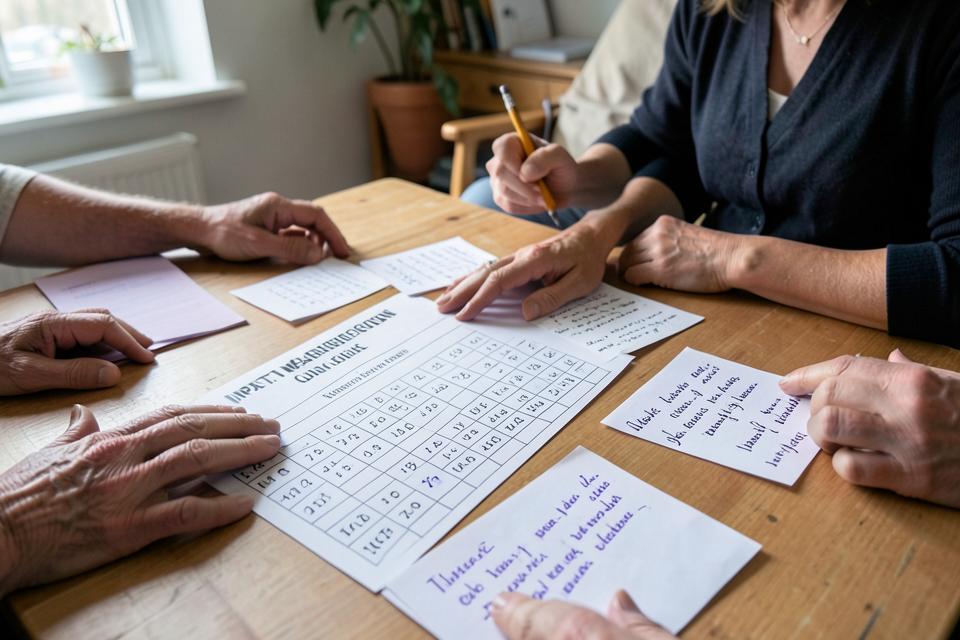
Why the form gets ignored
Picture the usual version. Two sides of A4, handed round at the end while people are putting their coats on. Fourteen questions, several of them repeating each other. A box asking for a postcode. A five-point grid with headings borrowed from a funder’s template. Nothing on it explains why any of it is being asked.
People are not refusing to engage. They are reading the form correctly. It was designed to produce a reporting line, not to find anything out, and the length signals that whoever wrote it was not thinking about the ten minutes it takes to fill in.
A short form that people finish beats a thorough one that half of them abandon, every single time.
There is a second cost that is easy to miss. A long form collected badly gives you a response rate so low that the results cannot carry any weight in a report. You did the work and still cannot use the answer.
What makes a question worth asking
Three tests. A question needs to pass all three.
- You will actually use the answer. If you cannot name the decision, the report line or the conversation it feeds, cut it. Collecting data you never look at costs you goodwill you will need later.
- It can be answered in one sentence or one tap. If a question needs a paragraph to answer properly, most people will skip it and the few who answer will not be typical.
- It is asked at a moment that makes sense. At the end of a session, in the room, beats an email three weeks later by an enormous margin.
A fourth test, less strict but useful: could you read this question aloud to someone without feeling awkward? If it only works on paper, it is probably written in reporting language rather than human language.
A question bank you can borrow
These are written to be asked out loud or put on a single short form. Take three or four, not all fifteen. Pick one from the “what’s changed” group and commit to asking it at the start as well as later, because that is the pair that gives you evidence rather than an impression.
How did this session go
Ask in the room, at the end, while it is still fresh.
- How was today for you, in a sentence?
- Was there anything you would change about today?
- On a scale of one to five, how comfortable did you feel here today?
- Was there a moment today that stood out, good or bad?
What's changed for you
Ask at the start and again later, in the same words both times.
- How easy would you find it to ask someone for help right now?
- Is there anything you can do now that you could not do when you started?
- How often in the last week did you speak to someone you trust?
- Has anything changed for you since you started coming here?
- What, if anything, would you do differently next time something like this comes up?
Would you come back, would you recommend it
The plainest test of whether something is working.
- Would you come again? Yes, no, not sure.
- Would you tell a friend in the same situation to come here?
- Is there anything that would stop you coming back?
What we should be doing differently
Only ask these if you are prepared to act on the answers.
- What is the one thing we could do better?
- Is there something you needed that we did not offer?
- Was getting here or getting in touch difficult in any way?
Print this question bank as a one-page sheet to keep with the sign-in folder.
Timing and method
In the room beats later
The best moment to ask is while the person is still there and the session is still in their head. A question asked at the door gets answered. The same question emailed a fortnight later gets answered by the handful of people who already liked you most, which is exactly the sample you should not be drawing conclusions from.
Verbal beats written, for some groups
Not everybody reads and writes comfortably, and a form can quietly exclude the people whose views matter most. Asking out loud and writing the answer down yourself is perfectly legitimate evidence, as long as you record it consistently and note that this is how it was collected. Tell people you are writing it down.
Shorter and more often beats longer and rarer
Two questions asked every week produce far more usable evidence than a fifteen-question survey once a year, and they do it without a fortnight of chasing. Frequency also means a bad month shows up while you can still do something about it, rather than in an annual report after the fact.
One caution on repetition: if you ask the same person the same thing every session for months, they will start answering on autopilot. Rotate the session-level questions and keep the change questions to a sensible interval.
Consent and sensitivity
People should know why they are being asked, what happens to the answer, and that saying no is a normal option with no consequence for the support they get. That can be one sentence spoken at the time. It does not need a form of its own.
Free text needs particular care
A person’s own words are the most valuable thing you will collect and the most identifying. Remove the name and a quote about a specific estate, a specific diagnosis and a specific week can still identify someone to anyone local. Before a quote leaves internal use, ask permission for that specific use, or paraphrase and say you have.
Keep sensitive answers to the people who need them, agree in advance who that is, and be careful with anything a person disclosed in distress. Consent given in the room to help you improve a service is not consent to appear in a public annual report.
Two smaller points worth building in. Anonymous responses get more honest answers about what went badly, so if the question is about your own performance, consider collecting it without names. And if someone tells you something that needs acting on, your safeguarding process comes first and the feedback question comes a distant second.
What to do with the answers
Read them the same week. Feedback that sits unopened until reporting season stops being feedback and becomes an archive. Tell people what changed as a result, even when the answer is that you could not change it and why. That is the single strongest thing you can do for next time’s response rate.
Keep the answers somewhere you can trace back to the session they came from. A quote you cannot date or attribute to a piece of delivery is a quote you cannot safely use.
Feedback is usually how the outcomes you care about most actually get evidenced, so measuring soft outcomes is the natural next read, and outcomes versus outputs covers what you are trying to show with it.
ImpactProof captures answers against the session they came from, so a quote or a score still has its context attached months later.